













By: Reuven Y. Epstein
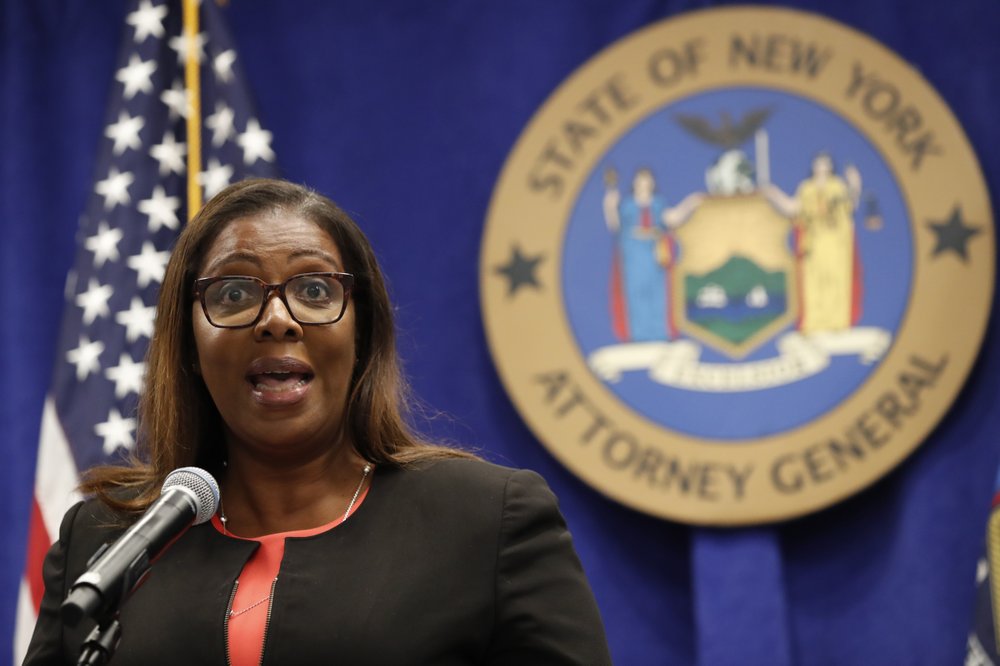
An exclusive report that appeared in The New York Post on Sunday has detonated a fresh political storm in Albany, revealing a deep and lucrative financial relationship between billionaire progressive kingmaker George Soros, his family, and New York State Attorney General Letitia James — a relationship that critics argue calls into question the independence of the state’s top law-enforcement office at a moment of profound legal and political volatility.
According to the New York Post’s exclusive investigation, Soros and members of his family have poured more than $71,000 directly into James’s campaign coffers since 2019, including $31,000 earmarked specifically to support her re-election bid next year. The disclosures, drawn from campaign-finance records, have already reignited debates over prosecutorial impartiality, ideological capture, and the blurred boundary between philanthropy and political leverage.
The New York Post’s exclusive report detailed how the Soros family’s financial support of James accelerated in recent years. In July 2024 alone, Soros himself wrote an $18,000 check to her campaign. Just weeks earlier, in May, his daughter-in-law, Jennifer Soros, contributed another $13,000.
These sums come on top of a further $40,000 in donations dating back to 2019, establishing a consistent pattern of support across multiple election cycles.
But as the New York Post report emphasized, the direct contributions tell only part of the story.
The same exclusive report uncovers a far larger financial ecosystem surrounding James: a dense network of left-wing political organizations that receive millions from Soros’s Open Society Foundation and then funnel resources into races that align with his ideological priorities.
Chief among them is the Working Families Party (WFP), a progressive powerhouse whose history is intertwined with James’s own political ascent.
According to records cited in the New York Post report, Soros’s ultra-woke grant-making empire has transferred $23.7 million to the WFP since 2016, largely through its fundraising arm, Working Families Organization Inc. Beyond that, Soros and his relatives personally donated another $865,000 to the New York branch of WFP since 2018.
James’s relationship with the party is not incidental. In 2003, she became the first Working Families Party candidate in state history to win office, securing a City Council seat representing Fort Greene and surrounding Brooklyn neighborhoods.
Although she declined to run on the WFP line in her pivotal 2018 attorney-general race — opting instead to align with then-Gov. Andrew Cuomo on the Democratic ticket — she returned to the party’s embrace in 2022, once again accepting its endorsement and championing its progressive platform.
Republicans wasted no time weaponizing the revelations. Michael Henry, a commercial litigator now running to unseat James in 2026, blasted the arrangement in comments quoted in the New York Post exclusive.
“George Soros has spent years financing the radical left’s most extreme projects, and the outcome is almost always the same: instability and disorder that is destroying our state,” Henry said.
“We saw it with [Manhattan District Attorney] Alvin Bragg, so no one should be surprised that Soros is heavily backing Letitia James’ ideological crusades and political vendettas that put New Yorkers’ safety on the back burner.”
Henry sharpened the attack with a line that has already gone viral in conservative media: “When the same donor who funds chaos underwrites New York’s top law-enforcement office, the results speak for themselves.”
James’s national profile has been shaped largely by her relentless legal battles with President Trump. The New York Post exclusive report noted that she made good on a campaign pledge from 2018 to investigate Trump’s real-estate empire, ultimately alleging that he fraudulently exaggerated his net worth over decades.
That case has already produced dramatic twists. In August, Trump secured a major victory when a state appellate panel overturned more than $500 million in fines imposed earlier in the proceedings.
Yet James herself has not emerged unscathed. In October, she was indicted on mortgage-fraud charges connected to a property she owns in Virginia — a development that electrified political circles nationwide. She pleaded not guilty, and the case was dismissed in November without trial. Since then, according to the report in The New York Post, repeated attempts by the Department of Justice to re-indict her have failed.
Trump has repeatedly accused Soros of orchestrating the legal assaults against him, alleging that James, Bragg, and other progressive prosecutors operate within a Soros-funded web designed to weaponize the justice system.
The White House declined to comment for the New York Post’s exclusive.
The New York Post investigation places James’s funding within a broader constellation of Soros-backed prosecutors. In Manhattan, District Attorney Alvin Bragg’s 2021 election was buoyed indirectly by a $1 million Soros donation to Color of Change’s political action committee, which then spent more than $500,000 on mailers, ads, and field operations promoting Bragg.
Soros and his family also gave Bragg $43,150 directly since 2021, including $22,500 since June.
This pattern — massive donations routed through advocacy organizations to reshape local criminal-justice policy — has become one of the defining features of Soros’s political strategy nationwide.
Efforts to obtain responses from the main players have thus far been met with silence. Michael Vachon, a Soros spokesman, refused to address the donations. The attorney general’s office did not return messages, and James’s campaign spokesperson was unreachable, according to the New York Post exclusive.
This absence of rebuttal has only intensified scrutiny, particularly as James prepares to campaign again in a state where crime remains a top voter concern and public trust in institutions is increasingly fragile.
At its core, the New York Post’s exclusive is not merely about campaign finance. It is about the architecture of influence in New York — how ideological networks, billionaire philanthropy, and prosecutorial power converge to shape public life.
For supporters of James, Soros’s backing is proof that she stands at the vanguard of a national progressive movement to hold powerful figures accountable. For critics, it is evidence of a justice system captured by donors whose priorities diverge sharply from those of ordinary New Yorkers.
As James readies her 2026 campaign, these revelations will loom large. The question voters will confront is not simply whether Soros’s money is legal — it is — but whether the state’s top law-enforcement officer can credibly claim independence while drawing from the coffers of one of the most polarizing political financiers in America.
In that sense, the New York Post exclusive may prove to be more than a campaign-finance exposé. It may become a defining document in the unfolding battle over who truly governs New York: the voters — or the billionaires behind the curtain.