





By: Ariella Haviv
In a season marked by accelerating diplomatic pressure and the steady drumbeat of geopolitical uncertainty, the annual AIPAC Congressional Summit in Washington unfolded this week as more than a routine gathering of political donors and lawmakers. It became, instead, a crucible in which the competing imperatives of American diplomacy, Israeli security, and Iranian nuclear ambition converged with unusual intensity.
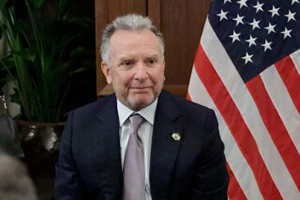
Jewish Insider which confirmed the details of the closed-door proceedings through sources familiar with the event, reported on Tuesday that White House Special Envoy Steve Witkoff addressed the summit on Tuesday, just days before he is scheduled to embark on a third round of negotiations with Iran in Geneva.
The timing alone imbued Witkoff’s appearance with symbolic weight. As the Jewish Insider report noted, the summit convened more than 1,000 of AIPAC’s most influential donors and activists from Sunday through Tuesday, a constituency that has long regarded Iran’s nuclear aspirations with existential alarm and has historically resisted diplomatic arrangements perceived as insufficiently stringent.
Witkoff’s presence before this audience, therefore, was not merely ceremonial. It represented a deliberate effort by the Trump administration to situate its current diplomatic posture within the broader ecosystem of pro-Israel advocacy in Washington, a community that wields significant influence over congressional attitudes toward Middle East policy.
AIPAC’s institutional memory loomed large over the proceedings. The Jewish Insider report recalled that the organization led a formidable lobbying campaign against the 2015 Joint Comprehensive Plan of Action, the nuclear agreement negotiated during the Obama administration.
That campaign included the creation of a specialized advocacy vehicle, Citizens for a Nuclear Free Iran, which expended more than $20 million in opposition to the deal. For many in the room, the JCPOA remains emblematic of what they regard as a perilous willingness to accommodate Tehran’s ambitions.
Witkoff, who now leads the Trump administration’s negotiations with Iran alongside Jared Kushner, confronted an audience steeped in skepticism about diplomacy with a regime widely viewed as duplicitous and ideologically hostile to Israel.
The Jewish Insider report situated Witkoff’s address within a carefully curated program that underscored AIPAC’s ongoing effort to project bipartisan credibility. The summit featured virtual remarks from Israeli Prime Minister Benjamin Netanyahu and opposition leader Yair Lapid, a juxtaposition that signaled the organization’s determination to engage with the full spectrum of Israeli political leadership.
On the American side, House Speaker Mike Johnson, Senate Minority Leader Chuck Schumer, and Senators Tom Cotton and Ted Cruz were among those expected to address attendees, reflecting an intentional balance between Democratic and Republican voices. For participants, this constellation of speakers reinforced the notion that support for Israel remains a rare axis of consensus in an otherwise polarized Washington.
The diplomatic subtext of the summit extended beyond Iran. The Jewish Insider reported that U.S. Ambassador to the United Nations Mike Waltz addressed the gathering on Monday, delivering a pointed critique of what he characterized as the entrenched anti-Israel bias within the U.N. system. One attendee recounted to Jewish Insider that Waltz spoke of the “absurd nature” of the institution and its perceived hostility toward Israel, even donning a hat emblazoned with the slogan “Make the U.N. Great Again.”
The sartorial flourish, while lighthearted, captured a deeper frustration among pro-Israel advocates who see multilateral forums as inhospitable terrain for Jerusalem’s diplomatic interests.
The emotional register of the summit reached a crescendo on Monday evening with a performance that transcended policy discourse. The Jewish Insider report described how Alon Ohel, a former Israeli hostage and accomplished pianist, took the main stage alongside John Ondrasik, the American singer-songwriter known professionally as Five for Fighting.
Ondrasik has emerged as a prominent voice in Israel advocacy during the Israel-Hamas war, and his decision to rerelease his signature song “Superman” in April 2025, dedicating it to Israeli hostages and to Ohel in particular, lent the performance a poignant resonance. In a hall otherwise devoted to strategic calculus and legislative maneuvering, the music served as a reminder of the human stakes embedded in geopolitical abstractions.
The presence of such personal testimony alongside high-level diplomacy underscored the summit’s dual character. As the Jewish Insider report observed, the speakers were “well balanced,” blending bipartisan lawmakers with senior administration officials and voices from Israeli civil society. This equilibrium was not incidental. It reflected AIPAC’s longstanding strategy of framing U.S.-Israel relations not merely as a matter of strategic alignment but as a moral partnership rooted in shared democratic values and, in moments of crisis, shared suffering.
Against this backdrop, Witkoff’s remarks assumed heightened significance. While the content of his address was not publicly disclosed, The Jewish Insider’s sources indicated that his appearance was closely tied to his impending discussions with Iranian Foreign Minister Abbas Araghchi in Geneva.
The fact that Witkoff chose to engage with AIPAC’s donor base at this juncture suggests an acute awareness of the domestic political terrain on which any future agreement with Iran will be contested. The Trump administration’s negotiations, like those of its predecessors, unfold under the shadow of congressional scrutiny and public skepticism, particularly among constituencies deeply invested in Israel’s security.
The dual role Witkoff occupies—as both diplomat and emissary to domestic stakeholders—illustrates the intricate choreography of modern American foreign policy. Jewish Insider’s coverage highlights how negotiations with Tehran are no longer confined to the rarefied realm of international diplomacy but are inseparable from the currents of domestic political mobilization.
The summit provided Witkoff with an opportunity to contextualize the administration’s approach, to signal resolve against Iran’s nuclear ambitions, and perhaps to reassure a skeptical audience that engagement does not equate to capitulation.
The broader geopolitical environment lent urgency to these deliberations. The Trump administration’s second-term approach to Iran has been characterized by a mixture of diplomatic overtures and rhetorical brinkmanship, a posture designed to extract concessions while maintaining a credible threat of pressure.
The Jewish Insider has consistently reported on the administration’s efforts to recalibrate U.S. strategy after the perceived shortcomings of the JCPOA, seeking a framework that addresses not only nuclear enrichment but also Iran’s regional activities and ballistic missile program. Witkoff’s Geneva talks with Araghchi are widely viewed as a critical inflection point in this recalibration.
For AIPAC and its supporters, the stakes of these negotiations extend beyond the technicalities of uranium enrichment or inspection regimes. They encompass a broader concern about the strategic balance of power in the Middle East and the security architecture that undergirds Israel’s survival in a volatile region. The Jewish Insider report noted how the summit’s discourse consistently framed Iran not merely as a proliferator but as a destabilizing force whose ambitions reverberate across multiple theaters of conflict.
The convergence of these themes—diplomacy with Iran, advocacy for Israel, and the mobilization of domestic political capital—rendered the summit a microcosm of contemporary American foreign policy’s entanglements. Witkoff’s address, situated within this milieu, exemplified the delicate balancing act required of envoys tasked with advancing negotiations abroad while cultivating legitimacy at home. The Jewish Insider’s account of the event reveals an administration keenly attuned to the optics and alliances that will shape the reception of any prospective agreement.
As the summit concluded and participants dispersed, the narrative threads woven over three days lingered in Washington’s policy circles. The image of a White House envoy speaking before AIPAC’s most committed supporters, even as he prepared to sit across the table from Iran’s foreign minister, encapsulated the paradoxes of American diplomacy in an era of entrenched polarization and high-stakes negotiation.
In the coming days, as Witkoff and Araghchi meet in Geneva, the resonance of the AIPAC summit will be felt in the corridors of power. Whether the talks yield substantive progress or merely extend the cycle of engagement and recrimination, the convergence of voices assembled in Washington this week underscores a central truth of contemporary geopolitics: diplomacy does not unfold in isolation. It is shaped, constrained, and sometimes propelled by the constituencies at home whose passions and anxieties imbue foreign policy with its enduring political charge.